A Guide for Inventors
Innovation is the foundation of technological progress, and patents play a crucial role in protecting innovative ideas. However, obtaining a patent begins with a well-prepared patent specification. Many inventors possess excellent technical ideas but often struggle to communicate them effectively in a patent application. Understanding the basic requirements for patent drafting can help inventors provide the necessary information and improve the quality of their patent applications.
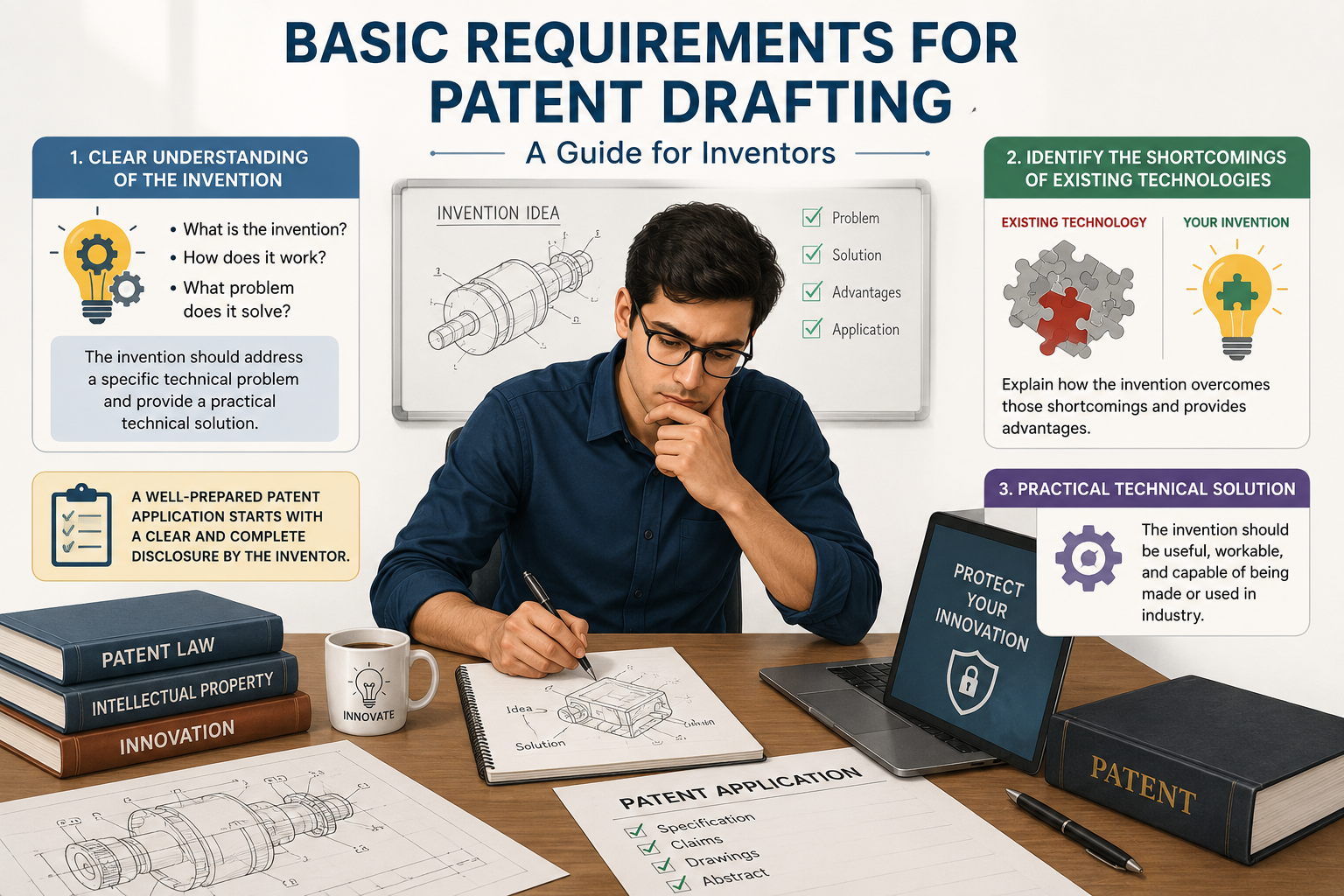
The first requirement is a clear understanding of the invention itself. An inventor should be able to explain what the invention is, how it works, and what problem it solves. The invention should address a specific technical problem and provide a practical technical solution. Before drafting begins, the inventor should identify the shortcomings of existing technologies and explain how the invention overcomes those shortcomings.

A patent application should contain a descriptive title that accurately reflects the subject matter of the invention. The title should be concise, specific, and informative. It should immediately indicate the field or nature of the invention without being overly broad or promotional.
Inventors should provide detailed technical information regarding the invention. This includes the structure, components, materials, processes, methods, algorithms, formulations, or systems involved in the invention. The description should be sufficiently detailed so that a person skilled in the relevant technical field can understand and reproduce the invention without undue experimentation.
One of the most important aspects of patent drafting is identifying the novel features of the invention. Inventors should clearly explain what makes their invention different from existing products, methods, or technologies. These distinguishing features often form the basis of the patent claims and determine the scope of legal protection that may be obtained.
Drawings, sketches, flowcharts, circuit diagrams, process diagrams, and illustrations are valuable tools in patent drafting. Visual representations help explain complex concepts and improve the clarity of the patent specification. Inventors should provide all available drawings and explain the function of each component shown in the figures.
The patent specification should also describe the working principle of the invention. It should explain how the invention operates and how the various components interact to achieve the desired technical result. Where applicable, the inventor should include examples, embodiments, prototypes, test results, or experimental data demonstrating the effectiveness of the invention.
Another important requirement is the disclosure of advantages achieved by the invention. These advantages may include improved efficiency, reduced cost, enhanced performance, increased reliability, better safety, reduced environmental impact, or other technical benefits. Demonstrating technical advantages can strengthen the patentability of the invention and support arguments relating to inventive step.
Inventors should also disclose alternative embodiments and variations of the invention. A broader disclosure helps ensure that patent protection is not limited to a single implementation and provides flexibility for future developments and modifications.
It is equally important for inventors to disclose the best method known to them for carrying out the invention. Patent laws generally require full and complete disclosure in exchange for the exclusive rights granted by a patent. Concealing critical information may weaken the patent and could affect its validity.
Before filing a patent application, inventors should evaluate whether the invention satisfies the fundamental patentability requirements of novelty, inventive step, and industrial applicability. The invention should be new, non-obvious to a person skilled in the art, and capable of being made or used in industry.
In conclusion, successful patent drafting depends upon the quality and completeness of information provided by the inventor. A well-documented invention with detailed technical disclosure, supporting drawings, experimental evidence, and clearly identified novel features significantly increases the likelihood of obtaining strong and enforceable patent protection. Inventors who invest time in preparing comprehensive technical information enable patent professionals to draft robust patent specifications that maximize the value of their innovations.