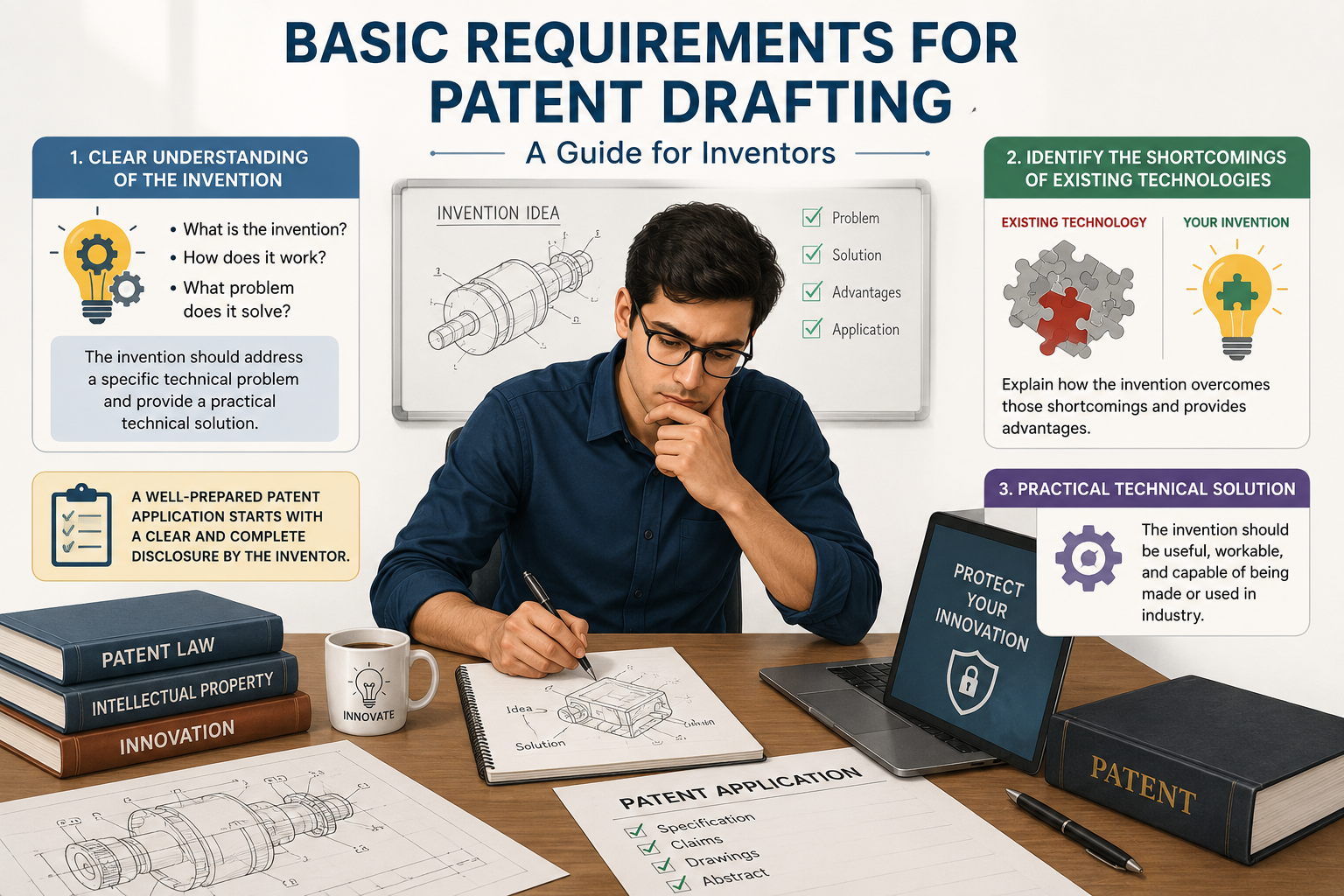

The Foundation of a Valid Patent Specification
Introduction
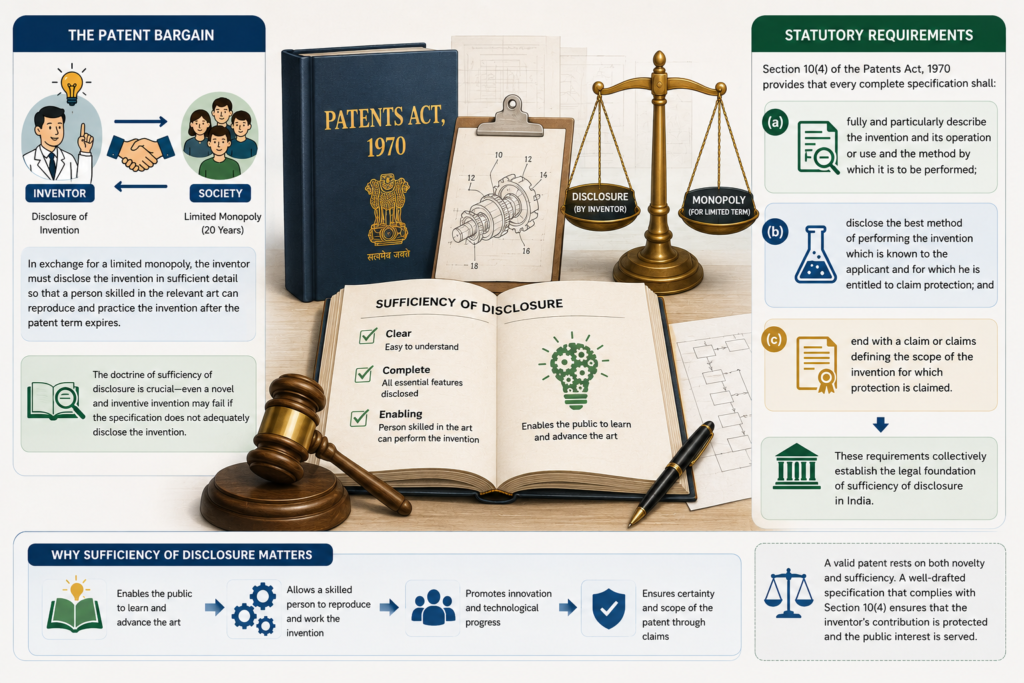
A patent is often described as a bargain between the inventor and society. In exchange for a limited monopoly over an invention, the inventor is required to disclose the invention to the public in sufficient detail so that a person skilled in the relevant art can reproduce and practice the invention after the patent term expires. This fundamental principle is embodied in Section 10(4) of the Patents Act, 1970, which sets out the disclosure requirements that every complete specification must satisfy.
The doctrine of sufficiency of disclosure is one of the most important requirements in patent law. Even a novel and inventive invention may fail to secure patent protection if the specification does not adequately disclose the invention. Consequently, patent applicants, inventors, and patent practitioners must ensure that the complete specification provides a clear, complete, and enabling disclosure of the invention.

Statutory Framework
Section 10(4) of the Patents Act, 1970 provides that every complete specification shall:
(a) fully and particularly describe the invention and its operation or use and the method by which it is to be performed;
(b) disclose the best method of performing the invention which is known to the applicant and for which he is entitled to claim protection; and
(c) end with a claim or claims defining the scope of the invention for which protection is claimed.
These requirements collectively establish the legal foundation of sufficiency of disclosure in India.
Meaning of Sufficiency of Disclosure
Sufficiency of disclosure requires that the patent specification contain enough technical information to enable a person skilled in the relevant art to perform the invention without undue experimentation. The disclosure must teach not merely the concept of the invention but also the practical manner in which the invention can be implemented.
The law does not require the specification to explain elementary principles already known to skilled persons. However, it must provide all essential technical information necessary to reproduce the invention and obtain the promised technical result.
The adequacy of disclosure is assessed from the perspective of a hypothetical “person skilled in the art,” possessing ordinary knowledge and skill in the relevant technical field on the filing date of the patent application.
Full and Particular Description of the Invention
The first requirement under Section 10(4)(a) is that the invention must be “fully and particularly described.” A complete specification should explain
- The technical field of the invention;
- The problem addressed by the invention;
- The essential technical features of the invention;
- The structure, composition, process, system, or method involved;
- The operation and functioning of the invention; and
- The manner in which the invention achieves its technical advantages.
Enablement Requirement
An important aspect of sufficiency is enablement. The specification must enable a skilled person to perform the invention across the claimed scope.
For example, if a patent claims a pharmaceutical composition, the specification should ordinarily disclose the composition, ingredients, concentrations, preparation method, and relevant experimental data. If a process invention is claimed, critical process parameters, operating conditions, and implementation details should be disclosed.
The disclosure should not require extensive research, inventive skill, or undue experimentation by the skilled person to practice the invention.
Judicial Perspective
Indian courts have consistently emphasized that the complete specification must provide a meaningful and enabling disclosure.
The sufficiency requirement is not satisfied merely because an inventor has conceived an idea. The patent specification must teach the invention in a manner that allows the public to practice it after the expiry of the patent term.
Courts generally examine whether the disclosure enables a skilled person to perform the invention without requiring further inventive effort. If essential information is omitted, the patent may be vulnerable to revocation or refusal.
Importance for Patent Drafting
From a drafting perspective, sufficiency of disclosure should be considered from the earliest stages of patent preparation. Inventors should provide:
- Detailed technical descriptions;
- Working examples;
- Experimental data;
- Drawings and flowcharts;
- Process conditions and operating parameters;
- Alternative embodiments;
- Comparative studies demonstrating technical advantages.
A well-drafted specification should anticipate potential sufficiency objections and provide adequate technical support for every essential feature that may later appear in the claims.
Consequences of Insufficient Disclosure
Failure to satisfy Section 10(4) can have serious consequences. The application may face examination objections, refusal, post-grant challenges, or revocation proceedings. Even if a patent is granted, an insufficient disclosure can undermine its enforceability and commercial value.
Therefore, applicants should ensure that the specification not only describes the invention broadly but also provides sufficient technical guidance for practical implementation.
Conclusion
Sufficiency of disclosure under Section 10(4) is one of the cornerstones of the Indian patent system. It reflects the fundamental principle that exclusive patent rights are granted only in exchange for a complete and enabling disclosure of the invention. A patent specification must teach the invention clearly, fully, and practically, allowing a person skilled in the art to reproduce the invention without undue experimentation. Inventors and patent practitioners who prioritize comprehensive disclosure during drafting significantly improve the strength, validity, and enforceability of patent protection. Ultimately, a well-disclosed invention not only satisfies legal requirements but also fulfills the broader objective of promoting technological advancement and dissemination of knowledge.