
Introduction
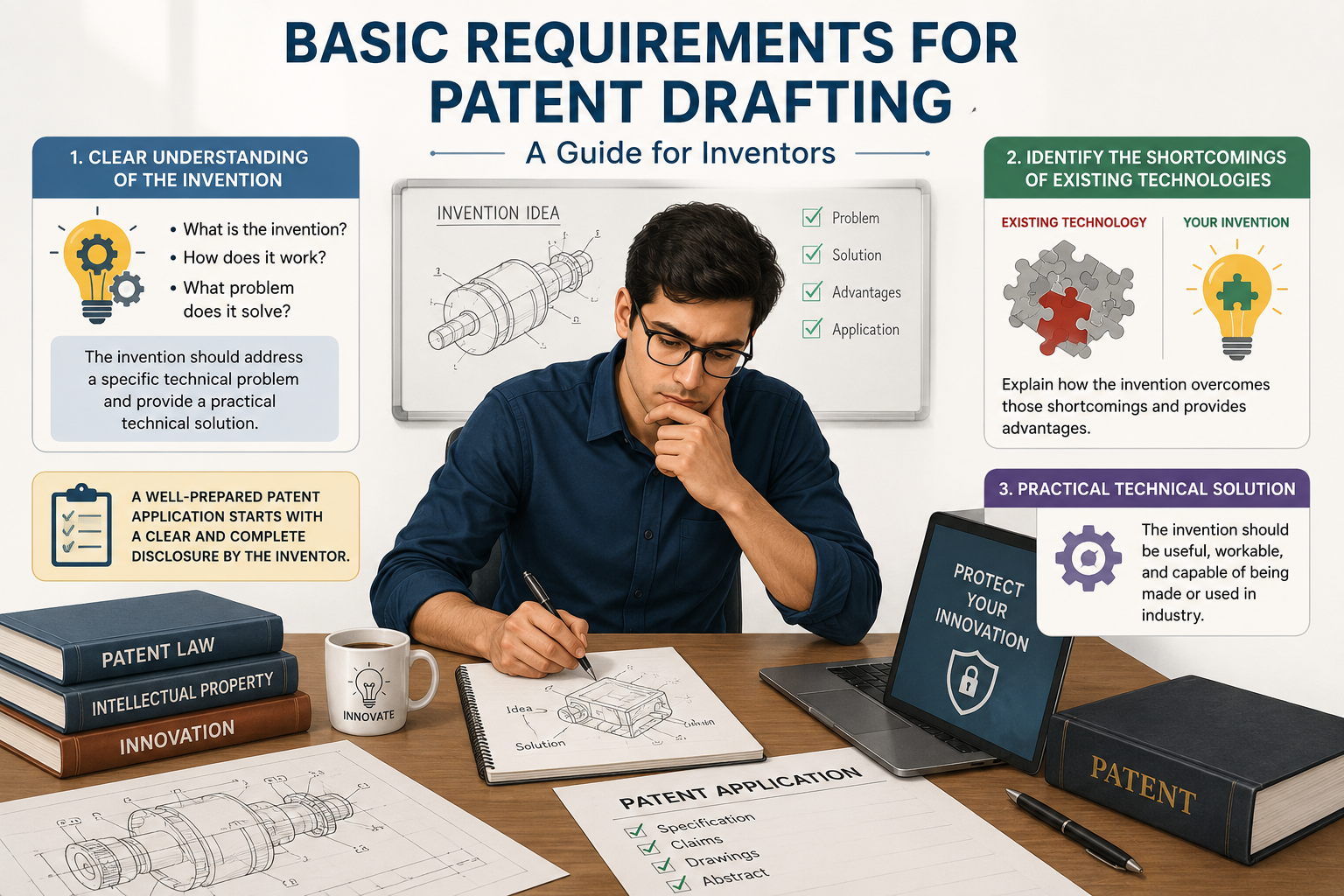
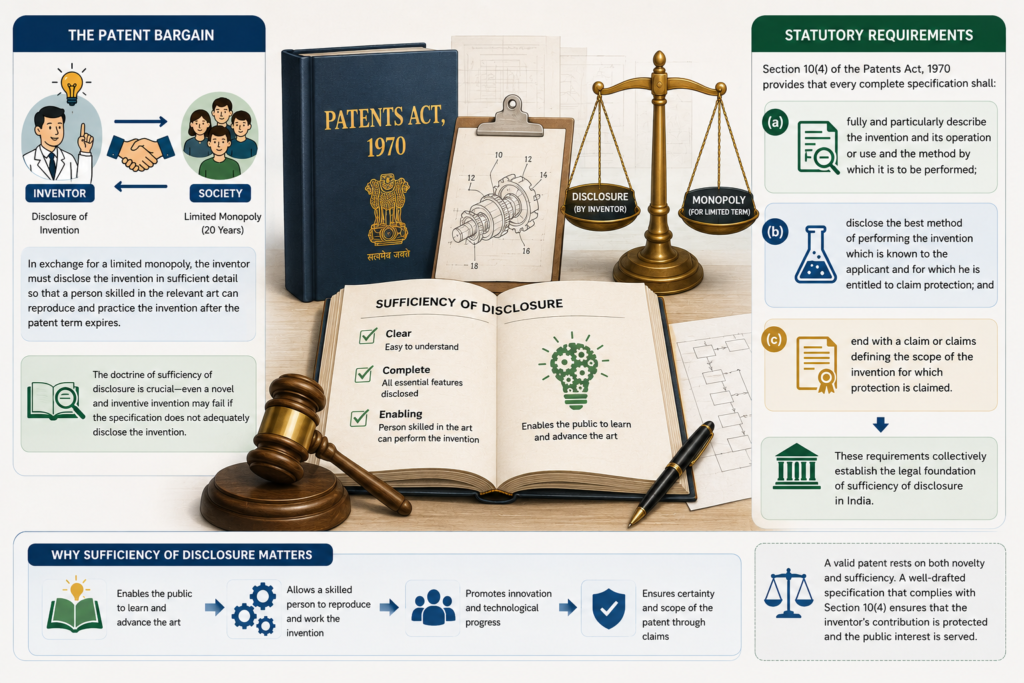
Patent law is founded upon a simple yet powerful principle: an inventor receives a temporary monopoly in exchange for teaching society how to practice the invention. This principle is often referred to as the “patent bargain.” While much attention is given to the exclusive rights granted by a patent, the corresponding obligation of disclosure is equally important. At the heart of this obligation lies the concept of enabling disclosure.
An enabling disclosure requires a patent specification to provide sufficient technical information so that a person skilled in the relevant field can make and use the invention without undue experimentation. Under Section 10(4) of the Indian Patents Act, 1970, every complete specification must fully and particularly describe the invention and the method by which it is to be performed. The requirement serves as a cornerstone of the patent system and ensures that patents contribute to technological progress rather than merely granting exclusive rights.
The Patent Bargain: Rights in Exchange for Knowledge
The patent system is not intended to reward inventors simply for having ideas. Instead, it rewards inventors for publicly disclosing their inventions. Society grants an inventor a limited period of exclusivity, generally twenty years, during which others are prevented from exploiting the invention without authorization. In return, the inventor must provide a detailed description of the invention.
Without an enabling disclosure requirement, inventors could obtain patents by merely describing an idea in broad or vague terms while withholding the practical knowledge necessary to implement it. Such an approach would undermine the very purpose of the patent system. The enabling disclosure requirement therefore ensures that the public receives meaningful technical knowledge in exchange for the temporary monopoly granted to the patent owner.
Promoting Technological Advancement
One of the primary objectives of patent law is the dissemination of technical knowledge. Every published patent specification becomes part of the global body of scientific and technological literature. Researchers, engineers, scientists, entrepreneurs, and students regularly consult patent documents to understand existing technologies and identify opportunities for further innovation.
When a patent contains an enabling disclosure, it contributes valuable technical information to society. Future innovators can learn from the disclosed technology, improve upon it, and develop new inventions. In this manner, the patent system promotes cumulative innovation and technological advancement.
If patent specifications were allowed to remain vague or incomplete, they would provide little educational value and would fail to advance scientific progress.
Preventing Unjustified Monopolies
Patents grant powerful exclusive rights. A patent owner may prevent competitors from manufacturing, using, selling, or importing the patented invention. Because these rights restrict competition, they must be justified by an adequate public disclosure.
The enabling disclosure requirement prevents applicants from claiming broad monopolies over technologies that they have not sufficiently taught the public to practice. An inventor should not be permitted to obtain exclusive rights over an entire field of technology merely by describing a desired result without explaining how that result can be achieved.
The requirement therefore acts as an important safeguard against speculative patenting and overbroad claims.
Ensuring Fairness to Competitors
Patent documents serve as a notice to the public regarding the scope of protected technology. Competitors should be able to understand what has been invented and how the invention operates.
An enabling disclosure promotes legal certainty by allowing competitors to evaluate the technology and determine whether alternative solutions can be developed without infringing the patent. It also enables competitors to prepare for lawful use of the technology after the patent expires.
Without adequate disclosure, competitors may face uncertainty regarding the true scope and technical content of the patented invention, resulting in unfair restrictions on innovation and market competition.
Facilitating Effective Patent Examination
Patent examiners assess whether an invention satisfies the requirements of novelty, inventive step, industrial applicability, and patentability. To perform this assessment effectively, examiners must understand the invention in sufficient detail.
An enabling disclosure allows patent examiners to evaluate the invention’s technical contribution and determine whether the claims are adequately supported by the description. It also assists examiners in identifying the actual inventive features and distinguishing them from prior art.
Incomplete or non-enabling disclosures often lead to objections, prolonged examination, and disputes regarding claim interpretation.
Supporting Patent Validity and Enforceability
A patent that lacks an enabling disclosure may be vulnerable to refusal, opposition, revocation, or invalidation. Courts and patent offices frequently scrutinize whether a patent specification adequately teaches the invention across the full scope of the claims.
The stronger the disclosure, the stronger the patent. A detailed and enabling specification provides a solid foundation for defending patent validity during litigation and post-grant challenges.
From a commercial perspective, investors, licensees, and potential business partners also place greater confidence in patents supported by comprehensive technical disclosures.
Preventing Undue Experimentation
A key objective of enabling disclosure is to ensure that a skilled person can practice the invention without engaging in extensive research or inventive effort. The patent specification should provide practical guidance rather than merely presenting a research objective.
For example, a pharmaceutical patent should disclose relevant formulation details, ingredients, concentrations, preparation methods, and experimental results. Similarly, a process patent should disclose essential operating conditions, process parameters, and implementation details.
The law does not require the patent specification to teach every elementary principle already known in the art. However, it must provide enough information to bridge the gap between the disclosed invention and its practical implementation.
Encouraging Better Patent Drafting
The enabling disclosure requirement encourages inventors and patent practitioners to prepare comprehensive and technically robust specifications. It promotes careful documentation of experimental work, prototype development, process optimization, and technical advantages.
As a result, patent specifications become more reliable, informative, and useful to both patent offices and the public. This improves the overall quality of granted patents and strengthens confidence in the patent system.
Relevance in Emerging Technologies
The importance of enabling disclosure is particularly evident in emerging fields such as artificial intelligence, biotechnology, pharmaceuticals, nanotechnology, and advanced manufacturing.
In these areas, applicants sometimes describe inventions using broad functional language without adequately disclosing the underlying technical mechanisms. Patent offices worldwide increasingly scrutinize such applications to ensure that the claimed inventions are supported by genuine technical teaching rather than speculative concepts.
The enabling disclosure requirement therefore serves as an essential tool for maintaining the integrity and credibility of the patent system in rapidly evolving technological fields.
Conclusion
The enabling disclosure requirement is far more than a procedural formality. It represents the fundamental exchange at the heart of patent law: exclusive rights in return for public knowledge. By requiring inventors to teach society how to practice their inventions, the patent system promotes technological progress, prevents unjustified monopolies, ensures fairness to competitors, facilitates effective patent examination, and strengthens the validity of granted patents.
Ultimately, a patent is not merely a claim to an idea. It is a technical teaching. The enabling disclosure requirement ensures that every patent contributes meaningful knowledge to society and fulfills the true purpose of the patent system—to encourage innovation while advancing the public storehouse of scientific and technological information.